
Table of Contents
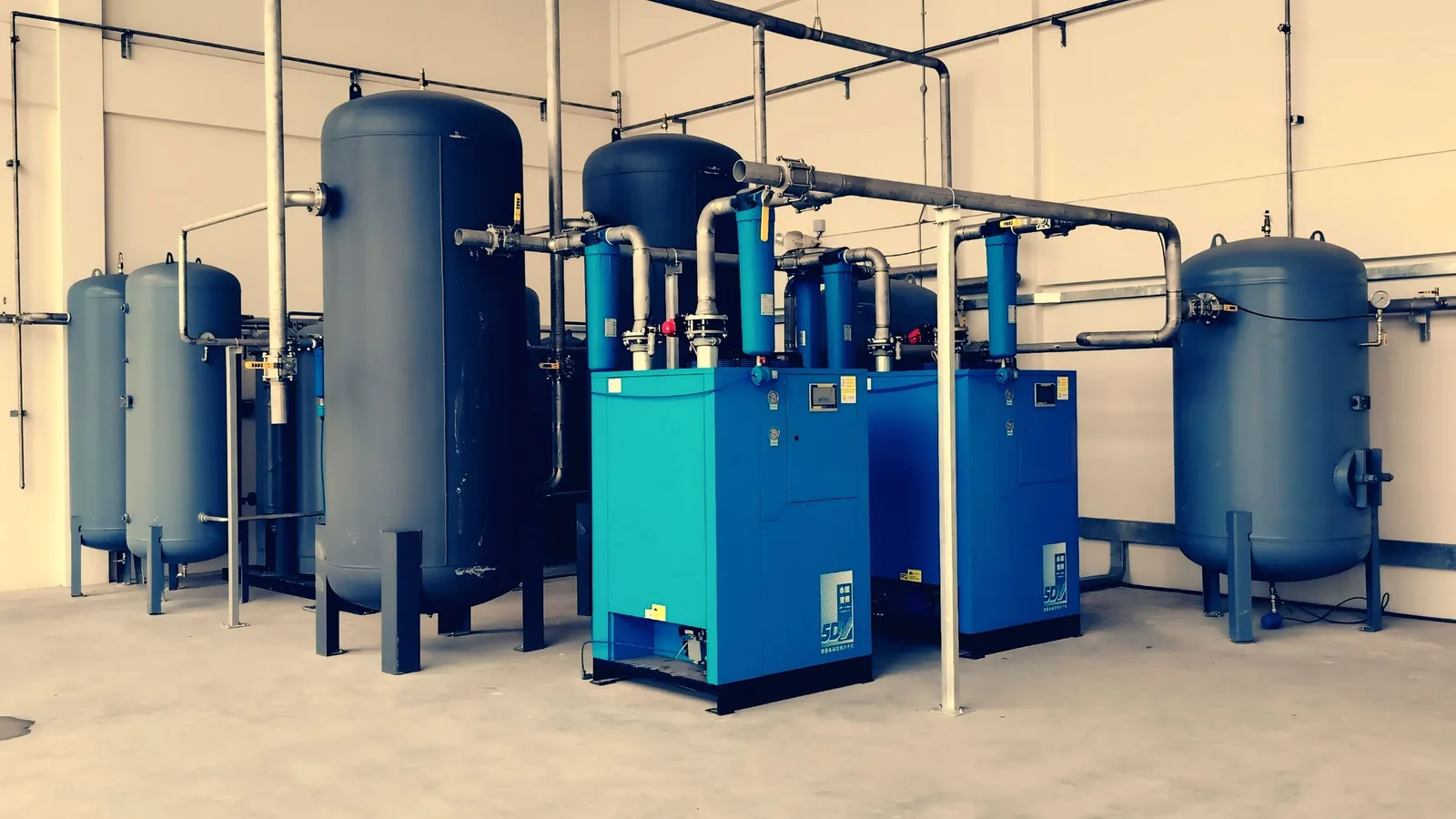
Someone has quoted you for a variable speed compressor. The saving sounds good. The price does not.
So the real question is not whether a VSD saves energy. It is how long it takes to pay for itself on your site, with your shift pattern and your electricity bill. That is what VSD compressor payback means, and it is a number you can work out before you sign anything.
Here is what our own jobs show, and the cases where we tell people not to bother.
What a VSD changes on your bill
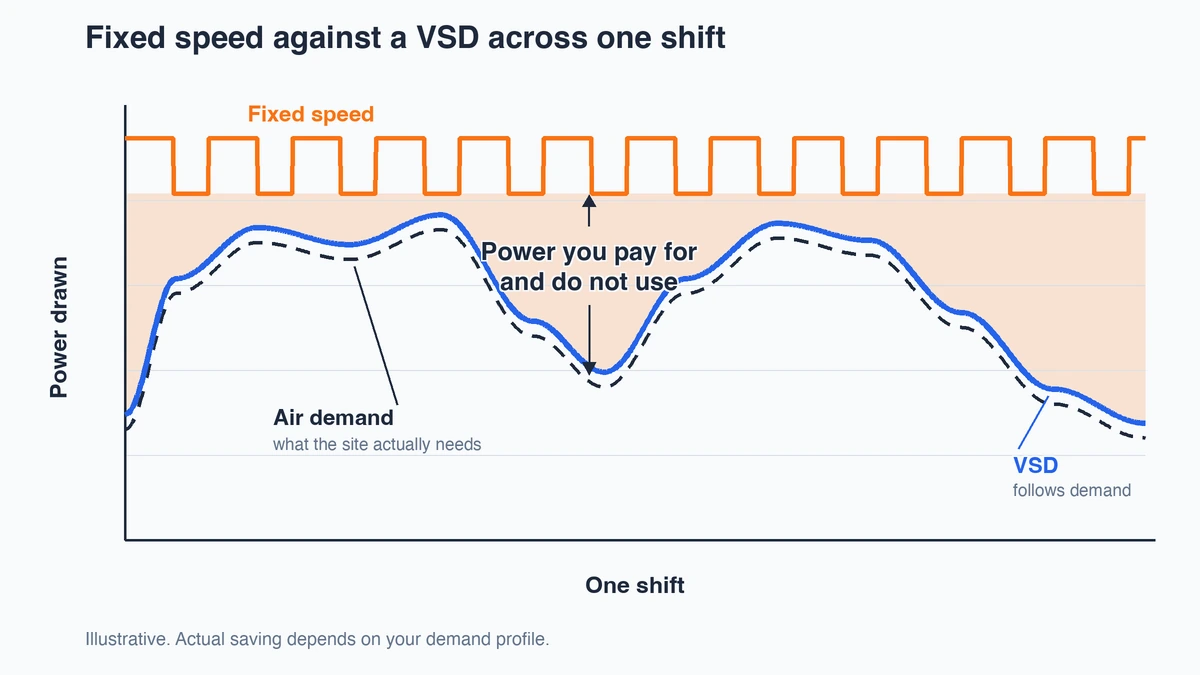
A fixed speed compressor has two settings. Full power, or offload. When your factory only needs 40% of the air, the motor still spins at full speed. It just dumps the air it does not need.
A variable speed drive compressor slows the motor to match the demand. Less air needed, less power drawn. That is the whole idea.
It matters because energy is the big number over a compressor’s life. Around 75% of the total lifetime cost of a compressor is the electricity it burns, as we set out in our efficiency guide. The purchase price is the small part.
What our own jobs actually save
On variable demand profiles, our own jobs show a saving of 15 to 35% of compressor energy costs against a fixed speed machine. That figure is on our VSD compressor page and it comes from the work we have done, not from a manufacturer brochure.
The range is wide on purpose. Where you land in it depends on how much your demand moves:
- Near 35%. Batch production, multi-shift work, big swings between busy and quiet. One compressor serving the whole site.
- Around the middle. Steady core demand with a busy period and a quiet period each day.
- Near 15%, or less. Demand barely moves. If it is genuinely constant, the saving will be minimal.
That last line is the honest one. We say it on our own product page and we say it on site visits.
Two other numbers get confused with this one, so it is worth being clear:
- A like for like swap to a newer machine, no VSD, typically saves 10 to 15% from the airend and motor alone.
- A full system redesign, covering compressors, treatment, pipework and controls, cuts total compressed air energy costs by 30 to 50% on older estates.
Both figures are on our compressor upgrades page. Neither of them is what a VSD on its own does. If a supplier quotes you 30 to 50% for swapping one machine, ask them to show their working.
VSD compressor payback: 12 to 36 months
Payback periods on our quotes typically run 12 to 36 months. On larger compressors running high hours, 5,000 or more a year, payback can be under 12 months.
Four things move the number:
- Compressor size
- Running hours
- Your electricity tariff
- How much your demand varies
A 90 kW machine running three shifts will pay back far faster than a 15 kW machine running days only. Same technology, very different maths.
The five numbers that set your payback
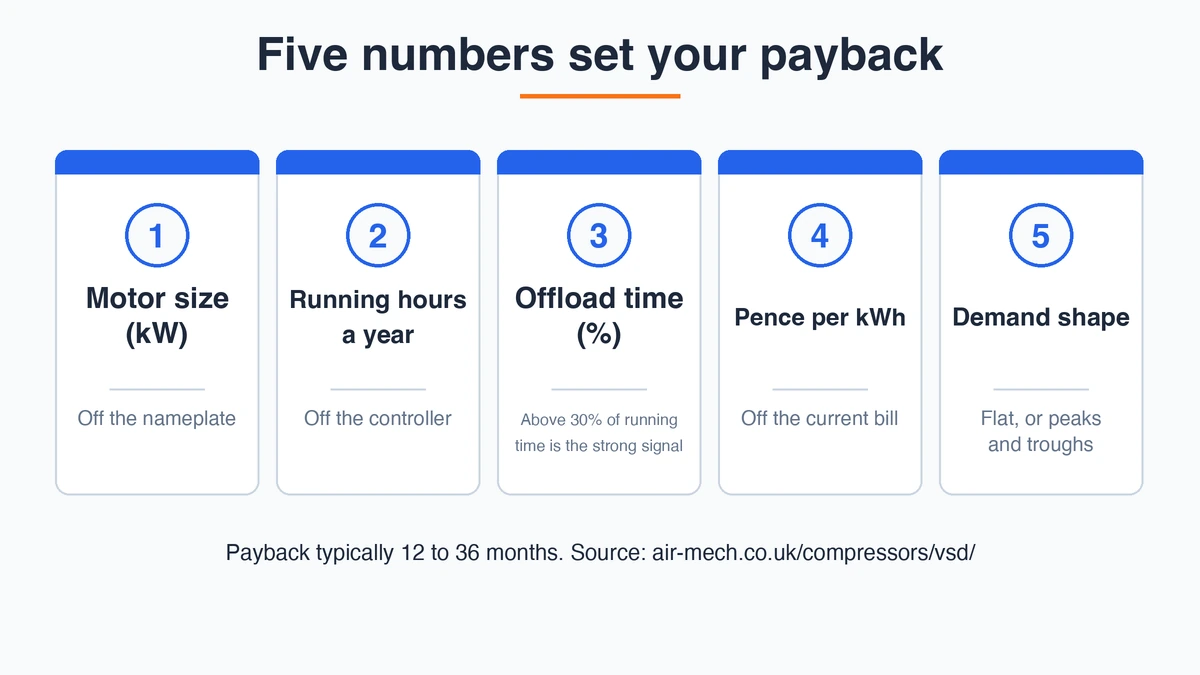
Before you ask anyone for a price, get these five figures. They take one logging exercise to collect.
- Motor size in kW. Off the compressor nameplate.
- Running hours per year. Off the controller, not off memory.
- Offload time as a percentage of running time. This is the big one. If your compressor offloads for more than 30% of the time it runs, a VSD is very likely worth costing.
- Your pence per kWh. Off the bill, not the tariff you had two years ago.
- The shape of your demand across a shift. Flat, or peaks and troughs.
With those five you can put a real range on the saving. Without them, any payback figure you are given is a guess dressed up as a number.
When a VSD does not pay back
Sometimes fixed speed is the better buy. We turn this work down when:
- Air demand is constant and predictable, such as a 24/7 base load.
- The compressor runs at or near full capacity all shift.
- You already run several compressors with a sequencer managing load and unload.
- The price difference cannot be justified for what the machine actually does.
- The plant room runs hot or has poor ventilation. Some drives are more sensitive to heat.
Those five come straight from our own VSD compressor page. We put them in front of customers because a VSD sold into a flat demand profile is a machine that never earns its premium back.
There is also a cheaper thing to do first. If nobody has surveyed your system for leaks, do that before you buy anything. Our ultrasonic leak surveys typically recover 20 to 30% of wasted energy, and fixing leaks costs a fraction of a new compressor. Buying a VSD to feed a leaking system is paying for air that never reaches a tool.
You cannot bolt a drive onto the compressor you already own
This comes up on nearly every enquiry, so here it is plainly. In most cases you cannot retrofit a variable speed drive to an existing fixed speed compressor.
A VSD compressor is a matched system. The motor, the drive and the airend profile are all designed for variable speed running. Fitting a drive to a standard motor can cause overheating, bearing damage and a voided warranty.
If your machine is old enough that you are asking the question, the right comparison is a purpose built VSD unit against a like for like replacement. Our guide to compressor upgrades walks through that decision.
How we prove the number before you spend it
We do not want you to take 15 to 35% on trust. Neither should you.
- We data log your system. Pressure, flow and power, recorded across real shifts. Compressed air data logging shows what your demand actually does, not what anyone remembers it doing.
- You get a written energy savings estimate with every VSD quotation. In writing, with the assumptions shown.
- You can check the maths yourself. Our energy savings calculator compares fixed speed and variable speed running costs using your own kW, hours and tariff.
- If you want the whole system assessed, an audit is cheap. A compressed air energy audit costs £800 to £1,500 for a single compressor site.
If you want to see what a finished job looks like, read our Flying Spares energy savings case study.
One last thing worth knowing. A VSD does not change your service bill much. The airend, filters, oil and separator need the same planned maintenance as a fixed speed equivalent. The drive itself has no wearing parts, but it does need periodic inspection, fan cleaning and firmware checks.
The short version
- Our own jobs save 15 to 35% of compressor energy on variable demand. On constant demand, the saving is minimal.
- Payback usually lands between 12 and 36 months, and under 12 on big machines running 5,000 hours or more.
- Offload time above 30% of running time is the strongest single signal that a VSD is worth costing.
- You cannot retrofit a drive to your existing compressor. It is a matched system.
- Fix the leaks first. Then log the system. Then get the quote.
Get the five numbers, and the decision makes itself.