
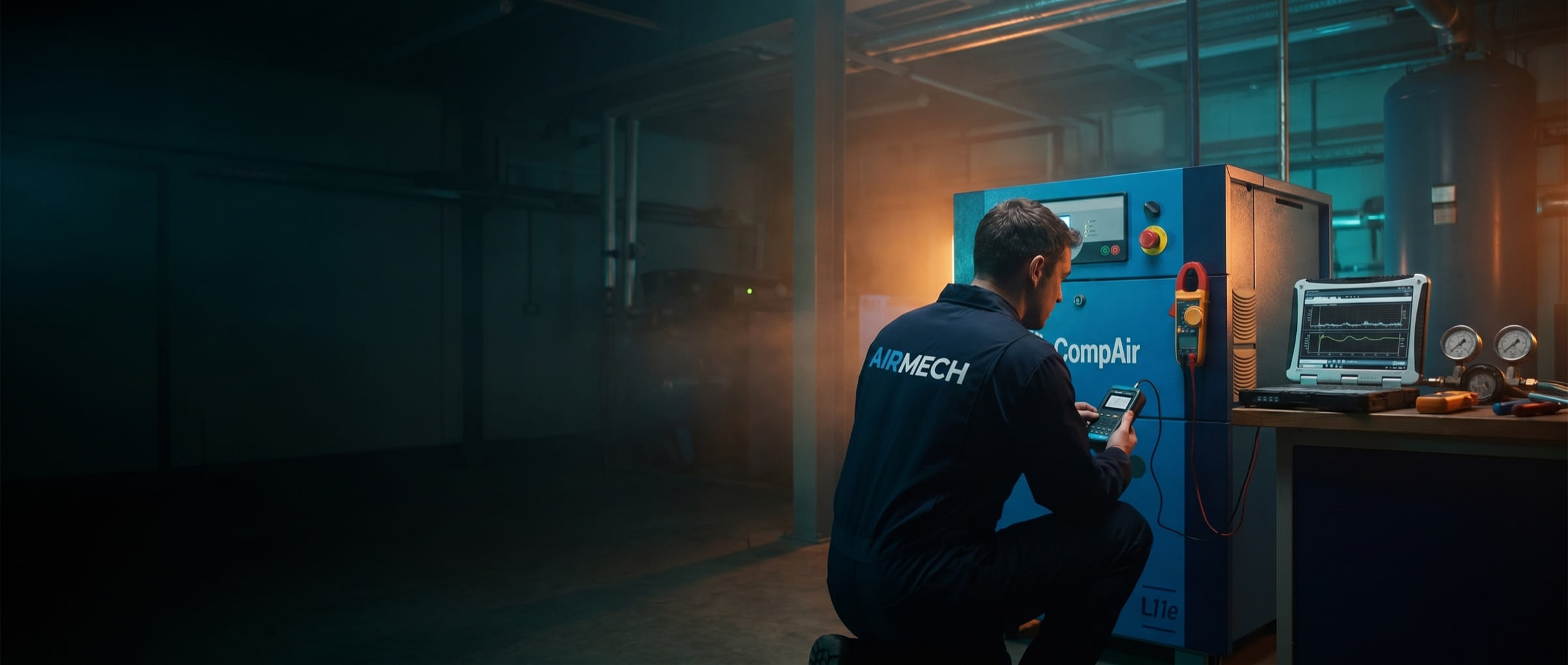
Compressed Air Quality Testing
Know exactly what is in the air your people breathe. Breathing air tested to BS EN 12021, with a certificate for every point tested and a clear pass or fail on every parameter. Where your application needs an ISO 8573-1 class, we specify the treatment to meet it and verify the filtration that delivers it.
You Know Something Is Wrong, But You Cannot Prove It
Leaks you cannot quantify. Quality risks you are not measuring. Compressors running more hours than they should. Wasted heat going up through the roof. You know something is not right, but you do not have the data to prove it or the clarity to act on it.
Without hard numbers, every conversation about compressed air investment stalls at the same point: what is it actually costing us, and what will the fix actually save? Guesswork does not get capital approved.
That is exactly what this audit delivers. Not a generic report with vague recommendations, but a ranked list of actions with costs, savings, and payback periods you can put in front of your finance team.
What We Check and How We Report It
We audit six areas of your compressed air system: air quality, energy consumption, leak losses, heat recovery potential, flow demand, and overall system sizing.
Our air quality testing is carried out to BS EN 12021, the standard for breathable compressed air. Each test records carbon monoxide, carbon dioxide, oxygen, oil content, water content converted to a pressure dewpoint, airline flow and pressure, and an odour check. You receive a certificate for each point tested, showing the measured values against the standard with a pass or fail on every parameter, and we report any non-conformance with our recommendation.
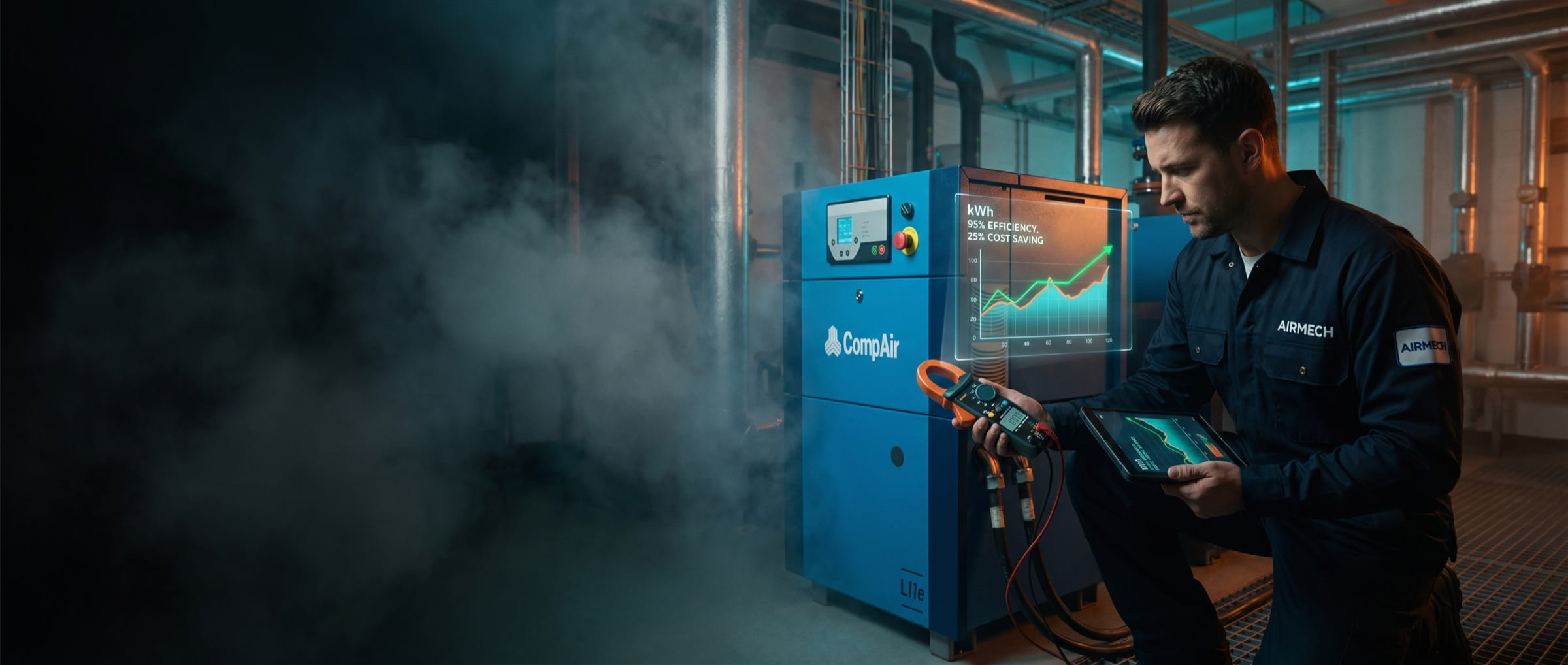
Energy audit includes power logging on each compressor over a minimum 7 day period, capturing load/unload cycles, specific power (kW per cubic metre per minute), and idle running costs. We benchmark your specific power against manufacturer specifications and industry best practice of 6 to 7 kW per cubic metre per minute at 7 bar.
Our full performance audits follow the methodology of ISO 11011 (Compressed air: Energy efficiency assessment), covering supply side analysis, demand side analysis, and distribution system assessment. This structured approach ensures nothing is missed and the report stands up to scrutiny from your energy manager or facilities team.
Every audit includes a Quick Wins Pack: three to five no cost or low cost changes you can implement immediately. The audit fee is credited against any remedial work completed within 60 days, so the audit effectively pays for itself if you act on the findings.
Air Quality Testing
Carbon monoxide, carbon dioxide, oxygen, oil content, pressure dewpoint, flow, pressure, and odour measured to BS EN 12021. A certificate for every point tested.
Air Treatment Review
Air treatment reviewed against your required ISO 8573-1 class. We check the installed filtration is rated for the class your application needs and that it is performing.
Energy Audit
Runtime logging, load and unload analysis, and efficiency benchmarking across every compressor. We quantify exactly how much energy is being wasted and where.
Leak Detection Survey
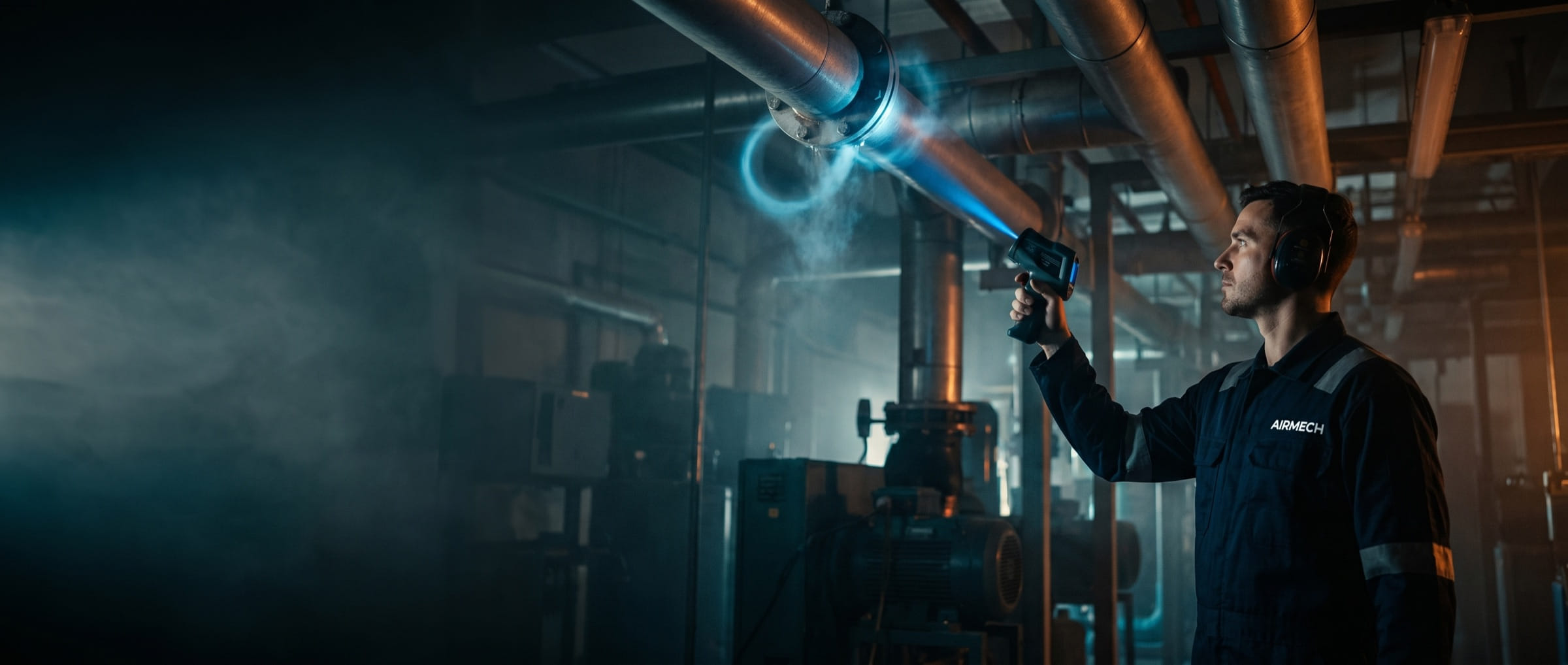
Ultrasonic leak survey with every leak tagged, photographed, and quantified in litres per second and pounds per year. You get a leak map and a prioritised repair list.
Flow and Demand Profiling
Peak and average CFM logging over a representative period. We validate whether your compressors are correctly sized for actual demand, not the demand someone estimated five years ago.
Report, Review, and Action Plan
Written report with every finding ranked by impact and cost to fix. Payback calculations included. We present the findings in person and agree the action plan with your team.
Filtration verified, not particles counted
ISO 8573-1 additionally classifies compressed air on particle counts at three size bands, which requires a laser particle counter under ISO 8573-4. We do not carry one, and we will not tell you we do. What we do instead is verify your installed filtration: our engineer checks that the filters on the line are rated to the class your application requires and that they are performing, before the test is carried out. The certificate states plainly that the filtration was verified rather than that particles were counted, because an auditor asking how a figure was reached deserves a straight answer. Where your specification requires a measured particle count, tell us at enquiry stage and we will either bring in a specialist for that element or advise you to place it separately.
What we do not do
We do not count particles, and we do not test for microbiological contamination. Our oil measurement is carried out on site rather than in a laboratory. Where your specification calls for any of those, say so when you enquire and we will tell you plainly whether we can help, bring in a specialist for that element, or point you to someone who does it.
We would rather lose a job at enquiry stage than have a gap turn up when your certificate is audited.
Which class applies to your line
For food and beverage production, BCAS Best Practice Guideline 102 recommends ISO 8573-1 class 2.2.1 for air in direct contact with product and class 2.4.2 for indirect contact, verified at least twice a year. Tell us which of the two applies to your line and we will tell you what we can evidence against it and what we cannot.
Airmech sits on the BCAS Distributor Committee.
Frequently Asked Questions
How long does an audit take?
A Focused Audit covering one or two areas takes half a day on site. A Full Performance Audit covering all six areas takes one to two days. Continuous Improvement Studies that require extended data logging may need a week of monitoring, but the loggers run alongside your existing system with no disruption. Data loggers record compressor power draw, system pressure, and flow rate at intervals as short as one second. This captures every load cycle, pressure fluctuation, and demand spike across a full production cycle including weekends. The data is then analysed to build your actual demand profile, identifying peak demand, average demand, and minimum night/weekend demand.
Will this audit disrupt production?
No. All data logging equipment runs alongside your existing compressed air system. There is no downtime, no isolation, and no interruption to your air supply. Our engineers work around your production schedule.
What do I actually get at the end?
A written report following a consistent structure: Executive Summary with the top 3 recommendations, detailed findings for each audit area, compressor performance data with graphs showing load profiles over the monitoring period, energy cost calculations with payback periods for each recommendation, and a Quick Wins section. Recommendations are colour coded: green (no cost, implement immediately), amber (low cost, payback under 12 months), and red (capital investment, payback over 12 months). You also get a review meeting to walk through the findings and agree next steps with your team.
Can I use the audit fee towards fixing the problems found?
Yes. The Implementation Credit means your audit fee is credited against any remedial work we complete within 60 days. If the audit identifies work worth doing, the audit effectively costs you nothing.
Do you test breathing air quality?
Yes. Breathing air testing covers oxygen content (19.5 to 23.5%), carbon monoxide (below 5 mg per cubic metre), carbon dioxide (below 500 mg per cubic metre), oil mist (below 0.5 mg per cubic metre), water vapour, and odour assessment. We test at the point of use, not just at the compressor outlet, because contamination can enter the system through pipework, fittings, and storage. Test certificates are valid for 3 months under BS EN 12021 and must be renewed regularly for ongoing compliance.
Find Out What Your Compressed Air Is Really Costing You
One call. We will discuss your system, your concerns, and which audit scope fits. No obligation, and the audit fee is credited if you act on the findings.